Picking between a low-cost Virtual Private Server (VPS) and a dedicated server used to be straightforward: tight budget, go VPS; deep pockets, go dedicated. In 2025 the line has blurred. Virtualization stacks have become lighter, NVMe drives cheaper, and network fabrics much faster. At the same time, hardware prices are volatile and many providers now sell “budget” dedicated machines that rival the price of premium VPS instances.
To help you decide which path makes sense for your next project, we break the comparison down into nine practical criteria. Keep score while you read; by the end you should have a clear winner for your workload.

1. Raw Performance & Hardware Isolation
Cheap VPS hosting
- Shares physical CPU cores with other tenants through a hypervisor. Modern KVM and Virtio drivers minimize overhead, but you can still experience a few percent loss versus bare metal.
- Burstable designs (often marketed as “shared CPU” or “fair share”) allow you to spike above your guaranteed baseline, yet sustained use may be throttled.
Dedicated server
- Provides 100 % of the CPU and RAM on the node. Ideal for noisy, multi-threaded workloads (database clusters, real-time analytics, video transcoding).
- No hypervisor layer means you can leverage CPU features like Intel SGX or AMD SEV without host restrictions.
Key takeaway: if your application is CPU-bound 24/7 and any variability hurts SLAs, bare metal still wins. For mixed or lightly loaded workloads, a modern VPS on NVMe will often feel indistinguishable.
2. Scalability & Elasticity
Cheap VPS hosting
- Most providers let you resize upward (and sometimes downward) in seconds. With PetroSky you can upgrade cores, RAM or disk from the dashboard without data loss.
- Horizontal scaling—spinning multiple small VPS nodes behind a load balancer—is faster and cheaper than cloning dedicated servers.
Dedicated server
- Vertical scaling usually equals migrating to a new box, copying data and re-provisioning DNS. Downtime can be hours if you do not plan ahead.
- Some hosts offer bare-metal APIs for on-demand deployment, but lead times still range from 10 minutes to several hours depending on stock.
Key takeaway: need elasticity for seasonal traffic or experimentation? VPS gives you cloud-like agility at a fraction of cloud prices.
3. Cost Efficiency (Total Cost of Ownership)
Cheap VPS hosting
- Starts as low as a few dollars per month. PetroSky’s entry plan bundles NVMe storage, IPv4 + IPv6, and DDoS mitigation for less than a cup of coffee a week.
- Real savings come from shared power, cooling and bandwidth at the host level.
Dedicated server
- Hardware rental is only phase one. Add RAID HBAs, remote KVM, replacement drives, plus a higher attack surface that merits stronger security tooling.
- Bandwidth quotas on budget dedicated plans can be stingy. Exceeding them triggers expensive overage fees.
Key takeaway: if cash flow is limited or unpredictable, VPS offers smoother cost scaling. Factor in opportunity cost—money not tied up in over-sized hardware can fuel marketing or development.
4. Management & Maintenance Overhead
Cheap VPS hosting
- Managed VPS plans bundle system patching, backup scheduling and proactive monitoring. PetroSky’s managed stack also includes AI-enhanced threat detection.
- Because the provider owns the hypervisor, failed disks and power supplies are invisible to you.
Dedicated server
- You shoulder every kernel upgrade, RAID rebuild and dead fan. Unless you pay for an add-on managed service, “server down” means your pager buzzes at 3 AM.
- You may gain IPMI or IP-KVM access but must secure these interfaces yourself.
Key takeaway: teams with limited DevOps bandwidth lean toward managed VPS. Dedicated hosting makes sense when you already operate an SRE team comfortable with hardware incidents.
5. Security & Compliance Requirements
Cheap VPS hosting
- Multi-tenant environments rely on hypervisor isolation. Modern kernels plus live patching have made escape exploits rare, yet some auditors still flag shared infrastructure for specific compliance frameworks (e.g., certain FedRAMP levels).
- Providers like PetroSky layer AI-driven anomaly detection and always-on DDoS scrubbing at the hypervisor edge, giving small teams enterprise-grade defenses.
Dedicated server
- Single-tenant nature eliminates the risk of noisy neighbors and data remanence across re-used partitions.
- You control firmware levels, hardware security modules, and physical disk custody—important for strict HIPAA or PCI DSS scopes.
Key takeaway: compliance trumps convenience. Validate control requirements; if hardware segregation is mandatory, go dedicated. Otherwise VPS wins on automatic patching and rapid remediation.
6. Network Performance & Latency
Cheap VPS hosting
- Modern virtualization exposes 10–25 Gbps vNICs with SR-IOV passthrough. PetroSky’s ultra-low-latency network peered with Tier-1 carriers keeps RTT stable for gaming or VOIP.
- Because multiple guests share uplinks, heavy traffic from another tenant can cause micro-bursts unless the host enforces per-VM policing.
Dedicated server
- Connects directly to the top-of-rack switch. Premium packages include 1–10 Gbps unmetered ports and optional LACP bonding.
- Perfect for bandwidth-hungry services like video streaming or large object storage nodes.
Key takeaway: need predictable high outbound throughput at all times? Bare metal is safer. For regionally distributed micro-services, the VPS’s shared Mbps is typically ample.
7. Customization & Root Access
Cheap VPS hosting
- Full root or Administrator is standard, but certain kernel modules or nested virtualization may be restricted. PetroSky enables KVM nested virtualization for Android emulation and CI/CD pipelines, yet GPU pass-through may be limited to specialized tiers.
- Cannot physically add PCIe cards or multiple NICs.
Dedicated server
- Swap or upgrade components, install a custom OS on raw metal, enable Intel TXT or Secure Boot toggles in BIOS—virtually unlimited freedom.
- Ideal when you need GPU compute, proprietary hypervisors, or exotic file systems that require kernel compilation.
Key takeaway: most web stacks, game servers or VPN nodes thrive on the standardized VPS template. Edge-case hardware requirements push you to dedicated.
8. High Availability & Redundancy
Cheap VPS hosting
- Snapshot and replicate disks across clusters. If the underlying host dies, the provider can automatically spin your VM on another node, often in minutes.
- Managed backups and any-time snapshot reverts simplify rapid disaster recovery.
Dedicated server
- Built-in redundancy depends on you: RAID, dual PSUs, separate switches. Geographic failover means renting two servers in distinct data centers.
- Failover orchestration, DNS cutover, and config sync are your responsibility.
Key takeaway: small businesses looking for “set it and forget it” resilience will value VPS auto-heal features. Enterprises with internal HA frameworks may still prefer dedicated pairs they can fully control.
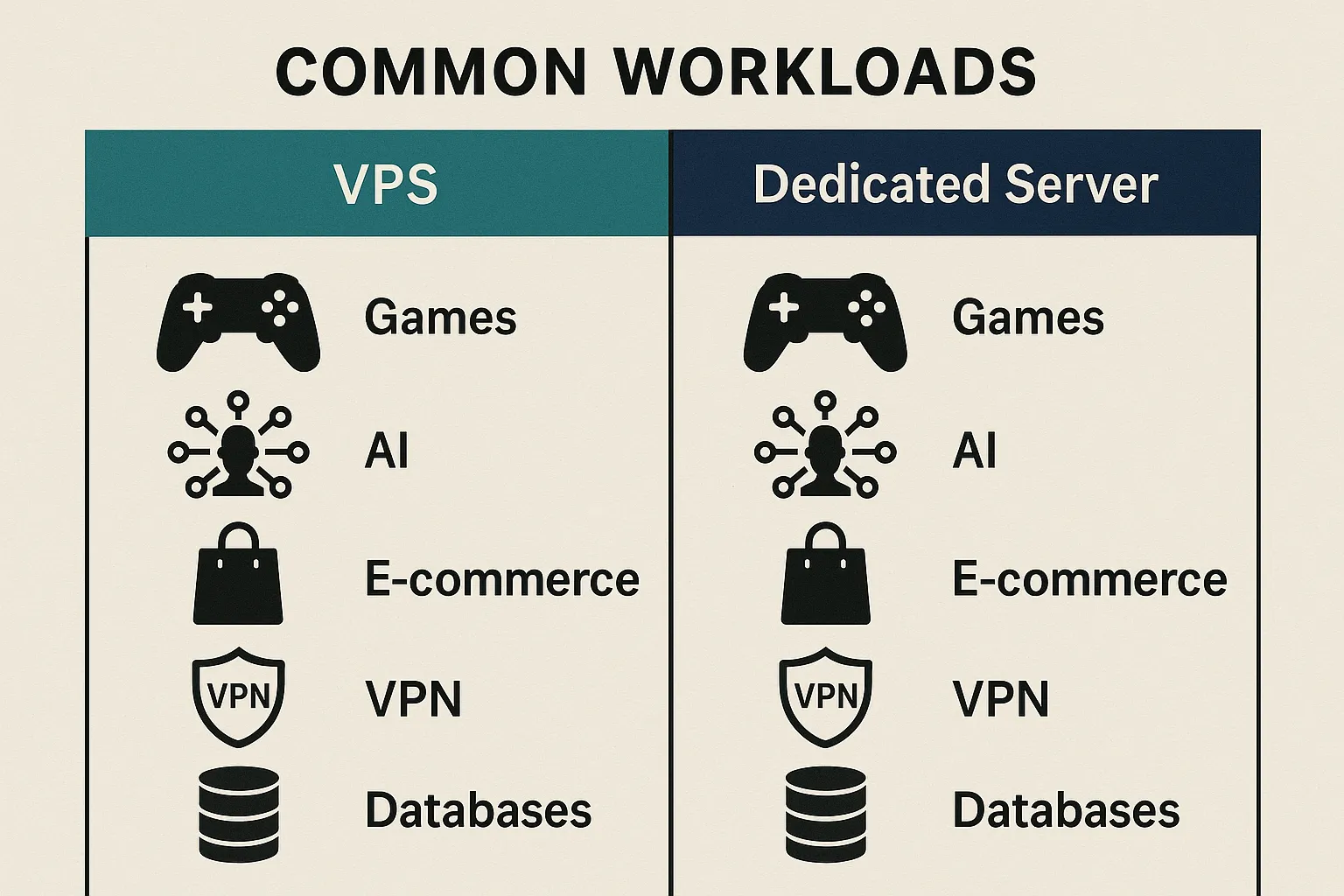
9. Use-Case Fit: What Are You Deploying?
When in doubt, map your application to one of these buckets:
VPS is usually better for
- Web hosting platforms (WordPress, SaaS dashboards, landing pages)
- Test, staging, or CI environments that spin up and down frequently
- Android emulator farms or BlueStacks automation needing GPU acceleration without full GPU pass-through
- Lightweight game servers (Valheim, Terraria) where 2–4 vCPU is enough and player peaks are unpredictable
- VPN or proxy endpoints that must exist in many global regions (cheaper to replicate multiple VPS nodes than bare-metal)
Dedicated server is usually better for
- Large multiplayer game servers (Minecraft with over 150 players, ARK clusters)
- High-frequency trading or real-time bidding platforms that squeeze every microsecond
- Machine-learning training jobs requiring full GPU or custom accelerators
- Compliance-sensitive data lakes needing physical disk custody
- Video encoding farms transcoding 4K streams around the clock
Checklist: Score Your Project
Use the table below to quickly tally which hosting mode leads for your scenario. Mark a point in the column that best matches each criterion; the higher total wins.
| Criterion | VPS wins | Dedicated wins |
|---|---|---|
| Performance stability | ||
| Elastic scaling | ||
| Budget control | ||
| Low maintenance | ||
| Compliance isolation | ||
| Network throughput | ||
| Custom hardware needs | ||
| Built-in redundancy | ||
| Workload fit |
Refer back to the nine sections above if you are unsure how to score a line.
Bringing It All Together
The “VPS vs. dedicated” conversation is no longer just about price. It revolves around:
- How volatile your workloads are
- How strict your compliance mandates stand
- How much operational toil your team can absorb
A cheap VPS gives you fast deployment, predictable monthly spend, and built-in safeguards. A dedicated server shines when every clock cycle triggers revenue or regulation requires hardware segregation.
Not Sure Yet? Start Small, Fail Fast
One compelling strategy is to prototype on VPS, gather real-world resource metrics, then migrate to dedicated once you have evidence that you truly need it. PetroSky supports both paths:
- Spin up an NVMe VPS in under a minute at petrosky.io/#pricing.
- When growth demands raw metal, our team can architect a hybrid migration—backed by the same AI-enhanced security stack and global Tier-1 network.
Ready to test drive? New customers receive $20 in credit when they deploy their first VPS before September 30, 2025. No credit card required—just verify your email and launch.
Still have questions? Chat with our engineers 24/7 or browse the detailed knowledge base covering kernel tweaks, Android emulator optimization, and more at petrosky.io/support.
Choosing the right hosting foundation is the first step toward a resilient, performant application. With the nine criteria above and an appetite for experimentation, you are well on your way to making an informed, future-proof decision.